Learn / Online Side Hustles: Legit, Fits Your Home, First Dollar
How to Become a UGC Creator: Portfolio, Pitch, and Pricing
Become a UGC creator with a three-video portfolio, a four-line pitch, and a quote that prices usage rights, with published 2026 rate data and worked math.
To become a UGC creator, you need three things before your first paid deal: a small portfolio of spec videos, a short pitch, and a quote that prices both the video and the right to use it. Brands don't buy your following. They buy a video and a license to use it. Beginners lose the most money on that second part. They quote a price for the video, say nothing about how it'll be used, and the brand runs it as a paid ad for a year while the creator gets paid once.
So yes, UGC can pay, but only as a priced service with written terms. Free videos for "exposure," unlimited revisions, and a flat fee with all rights thrown in pay you in experience. Experience doesn't cover rent. This guide shows you how to price the service.
Who this is for
You work a day job and you have nights free. You want to know whether making short videos for brands can actually pay, and what your first paid deal should look like. By the end you'll have:
- What a brand is actually buying, in four parts
- Published 2025 and 2026 rate data, with the disagreements stated
- A one-page quote sheet you fill in before every deal
- Three portfolio videos to film with products you already own
- A pitch structure and a two-week test with a failure diagnosis
What a brand actually buys
UGC (user-generated content) is short, casual-looking video, sometimes photos, that a brand posts under its own name. It goes on the brand's social accounts, product pages, emails, or paid ads. It isn't influencer marketing. An influencer sells access to an audience. A UGC creator sells a finished file. The brand's customers see the brand, not you. That's why Billo's guide to UGC jobs says plainly that UGC work doesn't require a following.
A brand order has four parts, and your quote should name all four:
- The deliverable. Usually one vertical video, 15 to 30 seconds, sometimes with hook variations (the same video opened in different ways).
- The use. Organic posting on the brand's own accounts is one thing. Running the video as a paid ad is a second, bigger thing. Running the ad from your account (TikTok Spark Ads or Meta partnership ads) is a third. Each is a separate permission with a separate price.
- The window. How long the permission lasts: 30 days, 90 days, six months, a year, or forever. Forever is called perpetual, and it's priced at a multiple of the base fee.
- The terms. How many revision rounds are included, when you get paid, and what happens if the project is cancelled. If you leave any of these out, the brand will fill them in for you.
What brands pay: the published numbers
Rates disagree across sources, and this guide says so instead of picking the friendliest number. None of these figures come from SHR's own measurements.
The marketplace center
Collabstr's 2026 Influencer Marketing Report, based on more than 21,000 collaborations, puts the average UGC price at $180 asked and $154 paid per engagement. It also says 80% of all engagements on its marketplace cost under $300. Treat $154 as the market's center for one engagement, not as your price. Your niche, deliverables, and usage terms move it.
What brands post in briefs
Knowlify's October 2026 roundup reports Pitchlo's count of 645 per-video UGC briefs posted between December 2025 and October 2026. The median offer was $100 per video. Half the listings fell between $50 and $200, and the top tenth offered $338 or more. By niche, the median was $90 for tech, $100 for beauty, $120 for lifestyle, and $150 for other niches grouped together. These are advertised budgets, not settled invoices, but they show what a cold pitch is competing with.
Beginner bands
Billo's guide puts entry-level creators with a handful of samples at roughly $50 to $150 per video, and creators with a stronger portfolio and reliable turnaround at roughly $150 to $500. The honest read: a beginner's first paid video lands somewhere in the $50 to $150 range. The fastest way to the upper end is a portfolio that proves you can open an ad, show a product working, and talk to camera.
Marketplace floors are lower
Knowlify reports that a US UGC video job on JoinBrands defaults to $60 and can't go below $50, before the platform fee. On Billo, creator payouts for a 15-second video start at $30 for new creators and $70 for premium creators, while brands pay from $99 a video. Marketplaces are the fastest route to a first paid job because the brand already has a budget. They're also the cheapest route, because the platform takes its cut and sets the floor. Direct deals pay more. Marketplaces pay first.
Usage rights are the second invoice
Knowlify reports Collabstr's finding that campaigns with usage rights averaged about 39% more ($307 versus $221), measured across all influencer campaigns, not only UGC. Influee's usage-rights guide gives a ladder on a $180 base: paid ads for 3 months add 20% to 30%, 6 months add 25% to 40%, a year adds 30% to 50%, and perpetual use adds 100% to 150%. Organic use is included in the base. Treat those percentages as one vendor's negotiating guide, not market data. The direction is the point: time and placement cost money, and "all rights included" is the most expensive phrase you can give away for free.
The trend working against you
Collabstr's 2026 report says average UGC campaign cost fell 5.7% year over year, from $209 to $197. Here's the myth to drop: the market isn't a rising tide that lifts every beginner. Rates are softening at the bottom. Your defense isn't a lower price. It's a portfolio that proves the work and a quote that charges for the use.
The One-Page Quote Sheet
Copy this sheet for every deal. Nothing ships until every line is filled in. A blank line is a term you gave away. These seven lines and their starter settings are SHR's recommendations, not any platform's policy.
- Deliverable. Number of videos, length, format, hook variations included, raw files or edited only. Example: "3 vertical videos, up to 30 seconds, edited, each with 3 hook variations."
- Creation fee. The price for making the videos, before any usage. Price per video, not per hour. Keep your first quote inside the published beginner band until your portfolio says otherwise.
- Usage, in four boxes. Organic posting on the brand's accounts: included, 90 days as a starter window. Paid ads from the brand's account: priced separately by window. Spark Ads or partnership ads from your account: priced separately again, per window, with the video named. Perpetual: never included by default. Price it at a multiple of the base fee, or turn it down. If the brand won't name the use, you don't have a quote yet.
- Revisions. One round of minor changes included. A reshoot isn't a revision. A new script or a new product angle is a new line item, priced before you film it.
- Exclusivity. If the brand wants you barred from working with rival brands, that's a separate fee for a set period and a named competitor category. No exclusivity clause means no lockout. Never sign an open-ended one.
- Payment. SHR's starter setting for a new client: 50% upfront, 50% on delivery, and a short due date on the balance. Add a late-fee line and a kill fee (a percentage owed if the project is cancelled after work starts). Send watermarked previews for approval and release final files after the balance clears. The license should start when full payment arrives.
- Disclosure. Who puts the ad disclosure on the content, in what words, and where. The friction section below explains why this line belongs in the quote.
A quote with all seven lines is a business document. A quote with one line, a price, is a favor with a number on it.
The math gate: one deal, quoted two ways
Here's a worked scenario with every input named so you can recompute it. The rates sit inside the published bands above. The hours are example inputs. Time your own first video and replace them.
The deal: a small skincare brand orders 3 videos. You're a beginner with spec videos and no client history. Your example creation fee is $150 per video, the top of Billo's entry-level band, backed by a portfolio that shows all three formats. Example hours per video: planning 0.5, filming 1.5, editing 1.5, one revision round 0.5. That's 4 hours per video and 12 hours for the set. The brand sends the product free. Free product isn't payment. It's a prop.
Deal A, quoted on the sheet
- Creation: 3 videos × $150 = $450
- Paid ads usage for about 90 days, at +30% of creation (the top of Influee's 3-month band): $135
- Total: $585
- Hours: 12, so $48.75 an hour gross, before tax, platform fees, and the unpaid hours you spent pitching
- If the brand wants a full year of paid use instead, Influee's 1-year band at +50% would be $225 on the same $450 base, priced before the ads run
- Cash timing: about $293 upfront and the rest on delivery
Deal B, the same deal as a flat fee
- "3 videos, $450, all rights included," the quote many beginners send
- Hours: still 12, so $37.50 an hour gross
- The brand can run the videos as paid ads for as long as it likes, and you get nothing more. On Influee's ladder, perpetual use alone is worth +100% to +150% of the base, or $450 to $675 on this deal, given away for free
- Cash timing: invoiced on delivery with no due date, so you wait for money on work you've already handed over
Same videos, same brand, same 12 hours. Deal A pays $585 with cash upfront and a priced path to more. Deal B pays $450 and gives away the most valuable part. The difference isn't talent or followers. It's a few lines on a quote sheet.
Two more comparisons. The marketplace version of this deal, three videos at the $60 JoinBrands default, is $180 before the platform fee. That's why marketplaces are a first-job tool, not a pricing strategy. And three free "test" videos for a brand that "wants to see how it goes" is 12 hours at $0, with files the brand can keep whether or not it hires you. Your portfolio already contains spec videos. That's what spec work is for. Charge for a brand's test, or point at your portfolio and decline.
To see what any deal really pays per hour once you count all your time, run it through the Income and Hourly Pay Calculator.
The portfolio: three videos, no client needed
You don't need a paying client to have a portfolio. You need three finished pieces, each 15 to 30 seconds and vertical, made with products you already own and use. Each format proves a different skill a brand is paying for:
- Problem-and-fix demo. Open on the problem, show the product working, end on the result. No talking needed. This proves you can show, not just tell.
- First-use video. Open the product and use it for the first time on camera, reacting honestly. This proves you can carry a real moment without a script.
- Talking review. Speak to camera with one claim, one proof, and one verdict. This proves you can say a brand's sentence like a person instead of reading it like an ad.
Film each with three different hooks (the opening line or shot). Label the work as spec: unpaid samples for products in your house. Brands don't care whether you were paid to make them. They care whether the video looks like something they could run tomorrow.
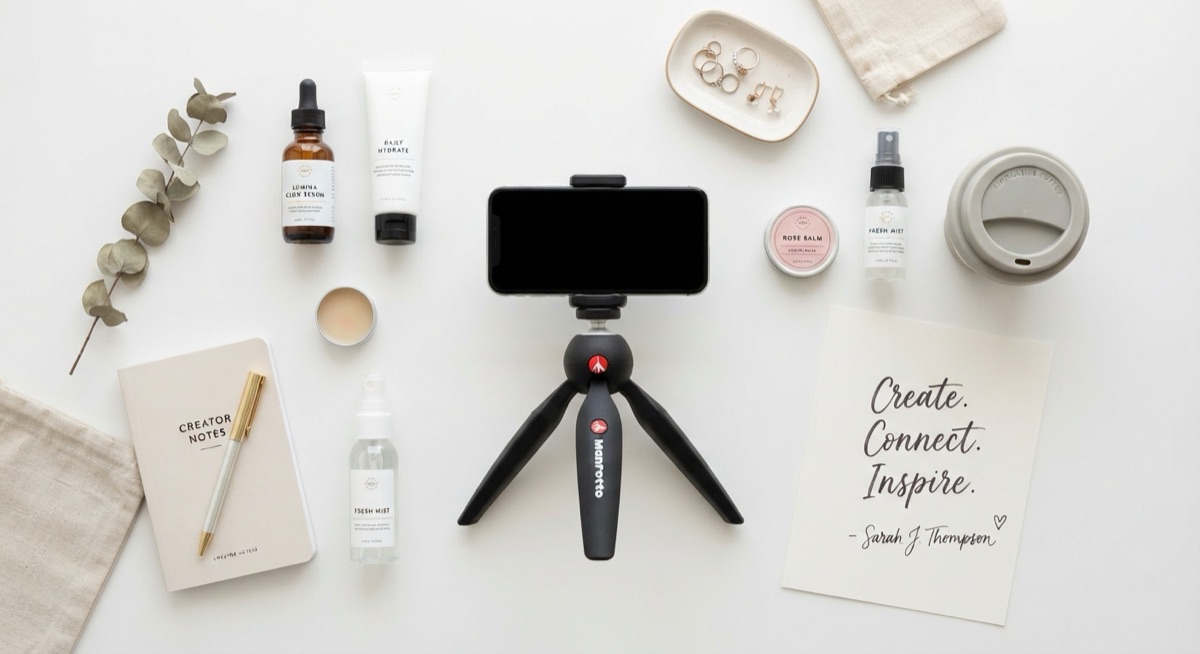
Gear is the smallest part of this. A modern phone, daylight from a window, and a cheap tripod cover the basics. Pick two niches, not ten, in categories you already use, so your spec videos look like they came from someone who knows the product.
Put the portfolio on one page: a dedicated social account labeled as your UGC portfolio, a one-page site, or a shared folder. A brand should see your work in seconds and find one way to reach you. Include a hero reel, your niche, sample work, your offer, and contact details. Nothing else.
Where the work comes from, and the pitch that gets replies
There are two channels. One is faster, the other pays more.
Marketplaces first, for the first paid job
Billo, JoinBrands, Collabstr, and similar platforms post briefs from brands that already have a budget. Fill in your profile completely and upload the three spec videos. Expect the floor prices above, and treat a marketplace job as proof of paid work, not as your rate. One paid job with a real brand's name on it helps your next direct pitch more than ten more spec videos.
Direct outreach second, for better money
Elev8or's 2026 UGC guide points direct pitches at small direct-to-consumer brands doing roughly $1 million to $20 million in revenue. Brands that size buy content constantly and rarely have an in-house creative team. Find brands already running video ads, since they have both a budget and a visible need. The same guide says to email them, not DM them. A pitch structure that works:
- Line 1, the gap you actually saw. Name the product and something true about how they market it now. "Your ads are mostly studio product shots" beats "I love your brand" because it proves you looked.
- Line 2, the offer, with a number. "Three videos, 20 to 30 seconds each, delivered in five days." Pitch a package, not a vibe.
- Line 3, proof, one link. Your portfolio page. No attachments.
- Line 4, the rate and one easy next step. Your creation fee plus the usage window, and a small ask like a short call.
Elev8or's working rule is about 20 pitches a week to brands in your two niches, and it calls a 5% to 10% reply rate normal, which works out to roughly one or two conversations a week. Treat that as one guide's reported norm, not a guarantee. Most pitches get no reply. No reply tells you something about the pitch or the target, not about you.
Who should wait
Wait if you can't name two niches you actually use. A portfolio of random products looks random. Wait if you're about to film a free test video for a brand that hasn't paid anything. Point at your portfolio instead. Wait if the only offer is free product in exchange for a video with paid-ad rights. That's a brand buying an ad with a prop.
Friction: what UGC does to you
Unpaid test videos
Your own spec videos are unpaid by design. They're your portfolio. A brand's "test video" is different: unpaid work for a specific business, with files that business keeps. Watch for warning signs like no mention of pay, a vague brief, multiple unpaid rounds, or no company information. The fair alternative is a small paid trial: one video, one fee, one rights line. A brand that won't pay for the first video has told you what the tenth will pay.
"One small edit" that's really a reshoot
Feedback is normal. A full reshoot dressed up as a five-minute favor isn't. A new outfit, a new angle, or a new claim can eat another half day of unpaid time. The quote sheet's revision line exists for this: one round of minor changes included, and reshoots priced before you film them. If a contract says final payment comes "upon complete client satisfaction" with no revision cap, you've signed up for unpaid work with no end date.
Usage creep
Organic permission isn't advertising permission. A brand that paid for organic posting and then runs the video as a paid ad has used a right it didn't buy. A brief isn't a contract. The rights agreement is what controls how the work gets used after delivery. Whitelisting works the same way: a TikTok Spark Ads code or a Meta partnership permission is a separate grant from the video itself, and it runs for a set window. Put the window in writing instead of relying on a platform default, and agree the renewal price before the first ad runs.
Slow payment is a second pay cut
Big brands often pay on 30-day terms or longer. Waiting months for payment is an interest-free loan you never agreed to give. An invoice with no due date is worse. The fixes are boring and they work: a deposit, a due date, a late-fee line, watermarked previews, final files after the balance clears, and a license that starts on payment.
Disclosure is your legal duty, not the brand's favor
The FTC's Disclosures 101 for Social Media Influencers says you need to disclose any material connection to a brand. That includes payment and free or discounted products, as well as personal, family, or employment ties. In a video, the disclosure goes in the video itself, not only in the description. Saying it and showing it on screen is better, since some people watch without sound. Vague terms like "sp," "spon," "collab," or a standalone "thanks" aren't enough. Clear words like "ad" or "sponsored" are. Don't assume a platform's built-in disclosure tool is enough on its own. And you can't talk about your experience with a product you haven't tried. The underlying rules are the FTC's Endorsement Guides, 16 CFR Part 255. This isn't legal advice. For a live deal, read the FTC's guidance yourself, and put the disclosure duty in your quote before the brand writes it for you in the smallest possible font.
AI-generated UGC
AI-generated presenters now compete for brands' cheaper testing work. If you use AI tools in your own production, the same disclosure logic applies: synthetic endorsements presented as real customers are the kind of thing regulators go after. The advantage a human creator keeps is the one AI can't fake, a real person who actually used the product saying so on camera. Don't give that up for a faster edit.
If you'd rather build something you own than sell your time per video, compare selling digital products and building a newsletter or AI services you can run on nights with a day job. Still choosing? Start with how to start a side hustle.
The test: this week, three videos, twenty pitches
Don't film anything for a brand yet. Here's the plan:
- Pick two niches you already use. Film three spec videos (demo, first-use, talking review), each 15 to 30 seconds with three hooks, using products already in your house. Label them as spec.
- Put them on one page: hero reel, niche, sample work, offer, contact. Fill in the One-Page Quote Sheet with your real numbers: creation fee inside the beginner band, organic use for 90 days included, paid usage priced by window, one revision round, 50% upfront.
- Send twenty pitches to brands in your two niches that already run video ads: the gap, the package, one portfolio link, the rate, one next step. Track every send and every reply with the brand and the date.
- Take no free test videos and no flat-fee all-rights deals. Your first paid job may come from a marketplace at the floor price. Take it as proof, not as your rate, and price the second job from the quote sheet.
Failure diagnosis. If nobody replies in two weeks, it's almost always one of three things, in this order. The pitch named no specific gap (rewrite line 1 with something true about that brand's current ads). The portfolio link showed everything instead of three strong pieces (cut it to three). Or the targets were wrong (brands with no video ads have no budget for video, so switch to brands already spending on it). Fix the pitch, the portfolio, or the list. Never fix the price by dropping it to zero. A free video doesn't fix a pitch problem. It just pays you nothing.
Nothing in this guide says what you'll earn. The math shows what one deal pays under stated assumptions. Change an assumption and the answer changes, which is why the quote sheet exists.
Get the next guide
Want the next guide in this series when it lands? Sign up for the Side Hustle Radar newsletter. That's the only ask on this page.