Learn / Online Side Hustles: Legit, Fits Your Home, First Dollar

Amazon FBA Product Research: The Fee and Margin Math First
Run Amazon FBA fee math before you order: 2026 referral, fulfillment, storage and ad costs, a five-gate scorecard, and a worked example at two prices.
Amazon FBA can pay, but fees decide whether it does, not demand and not a clever product idea. Before you spend a dollar on inventory, run the fee math on the product. If the math fails, more sales won't fix it. Selling more of a losing product just loses money faster. This guide shows you how to run that math in about ten minutes and gives you a five-gate scorecard that tells you pass or fail.
Picture a weeknight after work. You've found a kitchen gadget with steady sales, a supplier quote in your inbox, and a feeling that this is the one. The feeling is free. The first order isn't. The next ten minutes of arithmetic decide whether that order is a test or a loss.
Who this is for
You work a day job and you have nights free. You want to know whether selling a product through Fulfillment by Amazon (FBA) can actually pay. By the end you'll have:
- The fee stack Amazon charges on an FBA sale, layer by layer
- A five-gate scorecard you can run on any product
- A worked example at two prices, so you can see one product pass and the same product fail
- A one-week test with a failure diagnosis built in
Fee figures below are 2026 US rates. Amazon changes fees, so re-check them in Seller Central or Amazon's Revenue Calculator before you order anything.
The fee stack: what Amazon takes before you see a dollar
Amazon bills an FBA sale in layers. Learn the layers once and you can price anything.
Referral fee
This is a percentage of the sale price. Amazon's pricing page lists 15% for many categories, with a $0.30 minimum per item. The rate follows the product's category, not your listing, so look up yours instead of assuming 15%. Some exceptions that matter when you pick a category:
- Consumer Electronics: 8%
- Beauty, Health and Personal Care: 8% for items $10 or less, 15% above $10
- Clothing and Accessories: 5% up to $15, 10% from $15 to $20, 17% above $20
- Media (books, music, video, software): 15% plus a $1.80 closing fee per item
- Amazon Device Accessories: 45%
A 2026 fee guide from AMZ Prep reports that Amazon kept US referral percentages largely unchanged for 2026.
Fulfillment fee
This is a per-unit charge for picking, packing, shipping, and customer service. It depends on size, shipping weight, and price band. AMZ Prep's 2026 rate card lists these non-peak fees (January 15 to October 14, 2026) for a small standard item priced $10 to $50:
- Up to 2 oz: $3.32
- 2 to 4 oz: $3.42
- 4 to 6 oz: $3.45
- 6 to 8 oz: $3.54
- 8 to 10 oz: $3.68
- 10 to 12 oz: $3.78
- 12 to 14 oz: $3.91
- 14 to 16 oz: $3.96
Items under $10 sit in a cheaper band. The same 8 to 10 oz item is $2.77. On top of the fulfillment fee, a 3.5% fuel and logistics surcharge has applied since April 17, 2026 (eComEngine). It's charged on the fulfillment fee, not the selling price. Peak-season rates run higher, so check the current card before you price for Q4.
Storage fee
Storage is charged per cubic foot, per month, on the space your stock takes up. eComEngine lists standard-size storage at $0.78 per cubic foot from January to September and $2.40 from October to December. That's roughly triple in Q4.
Old stock costs more. AMZ Prep lists an aged inventory surcharge starting at $0.50 per cubic foot for stock held 181 to 210 days, rising to $6.90 at 366 to 455 days and $7.90 past 456 days. Holding more than about 22 weeks of supply can add a storage utilization surcharge on top. The lesson: order what you can sell well before day 181.
Account fee
On Amazon's pricing page, a Professional account is $39.99 a month with no per-item fee, and an Individual account charges $0.99 per item sold. The break-even is about 40 units a month ($39.99 ÷ $0.99). Below that, Individual is cheaper. Above it, Professional wins.
Advertising
This is the cost most beginners leave out. Sponsored Products ads are pay-per-click. Sequence Commerce's 2026 benchmarks put a typical Sponsored Products ACoS (ad spend as a share of ad-attributed sales) at 15% to 25%, and a platform-wide ACoS near 30% to 32%. They put average cost per click across ad types around $1.18 to $1.22. Those are third-party benchmarks, not Amazon-published rates. Your category, keywords, and listing quality move your real number. For your math, the point is that ads are a per-unit cost. A product that only works with zero ad spend stops working when launch week ends.
Smaller fees that still bite
AMZ Prep's rate card notes a low-inventory-level fee when an item drops under 28 days of supply, and reports that since January 1, 2026, Amazon no longer preps or labels US FBA inventory. Prep and labeling are now on you or on a prep service you pay. Returns carry their own costs. You can leave these out of your first rough pass, but put them in your real math before you scale.
The Fee-Stack Scorecard
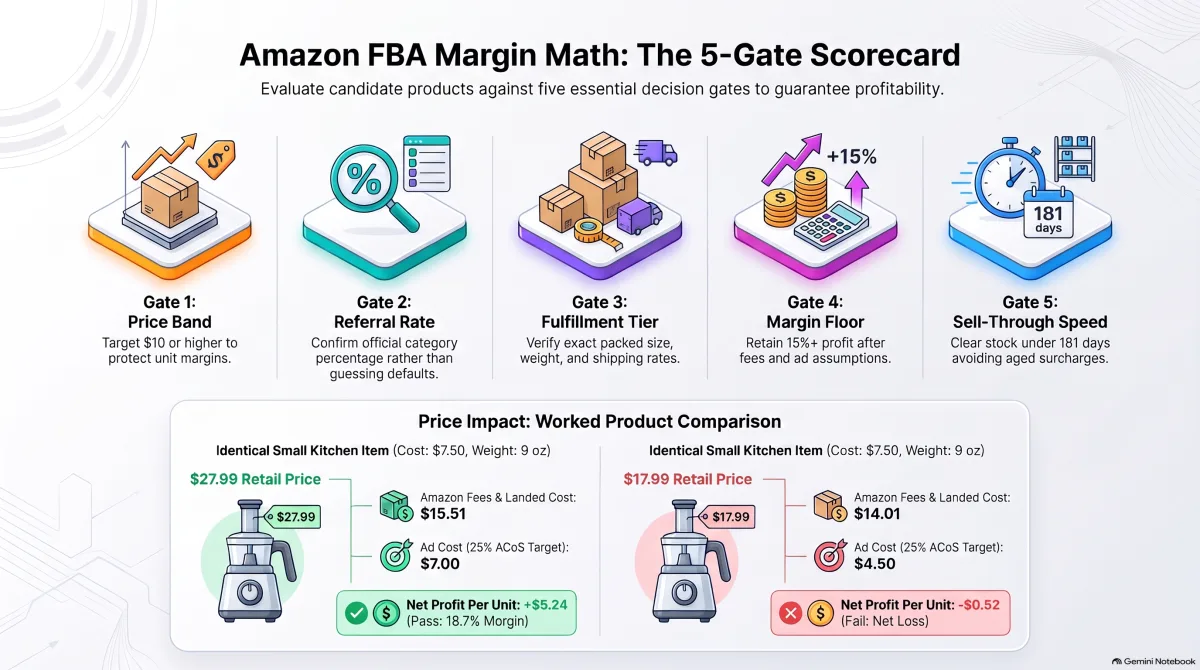
Copy this card for every product you consider. A product has to pass all five gates before you order. One fail kills it. Fix the input (price, landed cost, size, category), not the card. These gates and cutoffs are SHR's screening rules, not Amazon's. They exist to kill bad ideas fast.
- Gate 1, price band. Is the selling price $10 or higher? Under $10, the fulfillment fee eats a bigger share of the price and the $0.30 referral minimum starts to matter. Pass: $10 or more. Fail: under $10.
- Gate 2, referral rate. Did you look up your category's referral fee on Amazon's schedule? Pass: you wrote the real number down. Fail: you guessed 15%.
- Gate 3, fulfillment tier. Do you know the packed size tier and shipping weight? Pass: you know the tier and its 2026 fee. Fail: you used a generic "$3 to $5" placeholder.
- Gate 4, margin after ads. Does the product keep at least 15% of its price after referral, fulfillment, surcharge, landed cost, and a 25% ACoS planning assumption? The 25% is an assumption, not a promise. If your real ACoS runs higher, margin falls further. Pass: 15% or more left. Fail: under 15%.
- Gate 5, sell-through before day 181. Can you sell your first order before the aged inventory surcharge starts? Pass: order size divided by realistic monthly sales clears stock in under six months. Fail: you'd still hold stock at day 181.
The math gate: one product, two prices
Here's a worked scenario with every input named so you can recompute it. Fee inputs are the 2026 rates above. Product costs, size, and order quantity are example inputs. Replace them with your real supplier quote.
The product is a small kitchen gadget in Home & Kitchen (15% referral). It's small standard, 9 ounces packed, so the $10 to $50 fulfillment fee is $3.68. Example landed cost (product plus freight to Amazon) is $7.50 per unit. Example first order: 200 units at 0.05 cubic feet each, selling 200 a month, on a Professional account.
At $27.99
- Selling price: $27.99
- Referral (15% × $27.99): $4.20
- Fulfillment (small standard, 8 to 10 oz, $10 to $50 band): $3.68
- Fuel surcharge (3.5% × $3.68): $0.13
- Landed product cost (example): $7.50
- Total before ads and storage: $15.51
- Margin before ads: $27.99 − $15.51 = $12.48 (44.6%)
- Ads at a 25% ACoS planning assumption (25% × $27.99): $7.00, leaving $5.48
- Storage (200 units × 0.05 cu ft = 10 cu ft × $0.78): $7.80 a month, or $0.04 per unit at 200 units a month
- Account ($39.99 ÷ 200 units): $0.20 per unit
- Result: $5.24 per unit left (18.7%), which passes Gate 4
Now run it at a 30% ACoS, near the platform-wide benchmark. Ads cost $8.40 a unit, and the same product keeps $3.84 (13.7%). It fails Gate 4. That gap is why your ACoS assumption is a decision, not a detail.
The same product at $17.99
- Referral (15% × $17.99): $2.70
- Fulfillment: $3.68, plus $0.13 surcharge
- Landed cost: $7.50
- Total before ads: $14.01
- Margin before ads: $17.99 − $14.01 = $3.98
- Ads at 25% ACoS: $4.50
- Result: −$0.52 per unit before storage and account fees. It loses money on every sale.
Same product, same supplier, $10 less on price. One version passes. The other pays Amazon for the privilege of selling. That's the myth worth busting: a product that "sells a lot" doesn't fix a broken margin. Volume at a loss is still a loss. Price is a margin decision first and a marketing decision second.
Two more warnings the math carries. First, Q4 storage triples. The same 10 cubic feet costs $24.00 a month from October to December instead of $7.80, so price your Q4 stock with the Q4 rate. Second, the $10 floor in Gate 1 is real. Run the math at $9.99 with an example $4.00 landed cost: referral $1.50, fulfillment $2.77 in the under-$10 band, surcharge $0.10, and only $1.62 left before a single ad click.
To pressure-test a price against your own costs and time, plug your numbers into the Side Hustle Pricing Calculator.
How to research a product without guessing
Do the fee math first, then demand, in that order. A product with huge demand and failing math is one to skip, not one to fix with hope.
Demand: look for steady, not spiky
Start with Amazon's own signals. Type the product's main keyword and watch the suggestions. Check the Best Sellers Rank over several weeks, not one day. Read the top listings' review counts and dates. SHR's rule of thumb: if every top seller carries thousands of reviews, it's a long climb for a new listing. Paid research tools like Helium 10 and Jungle Scout can speed this up. Our verdict: run the free checks and the scorecard first, and only pay for a tool after a product passes Gate 4. A subscription doesn't rescue a failing product.
Competition: count sellers, not just listings
Open the top listings for your keyword. How many sellers share the Buy Box on the ones you'd compete with? A private-label product (your brand, your listing) avoids a direct Buy Box fight with sellers of the identical item. Reselling someone else's brand puts you in that price fight from day one. That choice changes your costs and risk, so make it before you open the seller account.
Supplier: get a landed quote, not a list price
The number that goes into Gate 4 is product cost plus freight to Amazon plus any prep you pay for. That's the full landed cost. A supplier's unit price alone isn't the input. Get the quote in writing, confirm what's included (packaging, labeling, freight, any duties), and rerun the scorecard with the real number. If the supplier can't give you a landed number, you don't have a product yet.
First order: small enough to sell through
Size the first order so it clears well before day 181 at a realistic monthly pace, not an optimistic one. Two hundred units at 200 a month clears in a month. Two thousand units at 100 a month is still sitting there when the aged surcharge starts. The first order is a test. It proves the listing converts and the math holds. The reorder is where you scale.
Friction: what FBA does to you
Fees move
The 2026 changes show the pattern. eComEngine reports fulfillment fees rose about $0.08 a unit on average, and the 3.5% surcharge arrived in April. AMZ Prep reports prep and labeling were handed back to sellers. A product that only works at last year's fees has an expiry date. Rerun the scorecard whenever Amazon announces a change, and keep a margin cushion for the next one.
The account is a gate
Seller verification asks for identity documents and a bank account. Some categories are gated and need approval. Restricted products can get a listing removed no matter how good the math looks. Check gating before you source, not after the shipment lands.
Reviews have rules with teeth
Incentivized reviews and review manipulation break Amazon's rules and can cost you a listing or the whole account. Early reviews come from real buyers, real follow-up, and a product worth reviewing. Anyone selling you a shortcut here is selling you account risk.
Returns cost money
Returned units don't always come back sellable. A fragile, fiddly, or sizing-sensitive product pays this cost more than a simple, durable one. Add a returns allowance to your math once you have return data. Before that, favor products with nothing to break, nothing to size, and nothing to assemble wrong.
Account health is boring and it matters
Policy violations, high defect rates, and late inventory compound into account-health problems. Accurate listings, honest claims, stock that arrives on time, and answered messages keep an account alive. No trick replaces them.
Who should wait
Wait if you can't fund the first order, the fees, and a small ad test without borrowing. Debt turns a test into a trap. Wait if your product only works under $10 or only with zero ad spend. Wait if you haven't checked whether your category is gated. Waiting isn't quitting. The cheapest failed product is the one you never ordered.
If FBA's upfront inventory cost doesn't fit your budget right now, start with a model that has no stock, like selling digital products or making UGC videos for brands. If you're still choosing between options, how to start a side hustle walks you through the pick.
The test: this week, three products, one scorecard
Don't order anything yet. Here's what to do this week:
- Pick three candidate products, in different categories if you can, so one bad category doesn't sink all three.
- Run each through the Fee-Stack Scorecard with real inputs: the category's referral rate from Amazon's schedule, the fulfillment tier from the packed size and weight, a real landed quote from a supplier, and the 25% ACoS planning assumption.
- Kill any product that fails any gate. Kill especially hard on Gate 4. Under 15% left after ads isn't a business. It's a hobby that charges you.
- Order nothing until one product passes all five gates. If all three fail, the test worked. Don't lower the gates to force a pass.
Failure diagnosis. If everything fails, the cause is almost always one of two inputs. Either the price is too low (pick a product that supports a higher price) or the landed cost is too high (find a cheaper landed quote, or a lighter, smaller product in a lower fulfillment tier). Fix the input. Never fix the scorecard. A scorecard you edit until it passes doesn't test anything.
Nothing in this guide says what you'll earn. The math shows what one product keeps under stated assumptions. Change an assumption and the answer changes, which is exactly why you run the scorecard.
Get the next guide
Want the next guide in this series when it lands? Sign up for the Side Hustle Radar newsletter. That's the only ask on this page.