Learn / AI Side Hustles for Beginners With a Day Job

AI Side Hustles With a Day Job: Services That Fit Your Nights
AI side hustles that fit a day job: three night-friendly AI services, a capacity ledger for your hours, and worked retainer vs audit math. No hype.
AI side hustles can work with a day job, but only the services that fit inside your nights, and only if you count the upkeep hours. Selling AI services to small businesses pays as setup fees plus monthly upkeep, not as passive income. The version that fits a day job is a small number of clients on narrow systems you can maintain after work. Tools are cheap and easy to buy. Your hours are the only input you can't buy more of, so this guide starts with them.
It's 9:30 on a Tuesday night. You've seen a dozen videos about AI agencies "running on autopilot." None of them asked the question that decides everything: when, exactly, will you do the work?
Who this is for
You work a day job and you have nights and weekends free. You want to know whether selling AI services to small businesses can pay without quitting your job. By the end you'll have:
- Three AI services that fit night hours, and one that doesn't
- A ten-line Nights Ledger that turns your real hours into a client ceiling
- A worked month showing what a retainer model and an audit model each pay per hour
- Ten businesses to check and five emails to send this week
The bottleneck: your night-hours budget
Your service business runs in the hours left over after the day job: weeknights after dinner and a weekend block. A service that needs daytime availability, fast daytime replies, or constant monitoring doesn't fit, no matter how good the price looks. A service that takes six hours to set up and two hours a month to maintain does fit, as long as the client count stays small.
So count your real hours first. That means after the day job, after family, and after rest, not the version where you work every night until midnight. That number decides which service you sell, how many clients you take, and what price makes the hours worth it. Pick the service before you count the hours and you'll sell something you can't deliver.
What you're actually selling
An AI service business sells three things, in this order: setup, judgment, and upkeep. Not software. The client can buy the software themselves. What they can't easily do is pick the right tool, connect it to their phone and booking system, write the messages it sends, check that it doesn't make up their prices, and fix it when it breaks. That's the service. The AI is one component inside it, the way a wrench is one component of a repair. Nobody pays for the wrench. They pay for the person who knows which bolt to turn.
That definition knocks out half the idea lists online. If it's mostly "the AI does it" with no setup, judgment, or upkeep, it isn't a service. It's a subscription the client could buy directly. If it needs you available all day, it isn't a nights business. What's left is narrow, boring, and sellable: one system, for one kind of business, that you install and keep running.
Three services that fit nights
1. Missed-call text-back
When a customer calls a small business and nobody picks up, the system sends an automatic text: "Sorry we missed you, how can we help?" The reply lands on the owner's phone as a lead, and the owner calls back. Trades, salons, clinics, and cleaners buy it, meaning any business where the owner answers their own phone and can't always get to it.
Your deliverable is a working text-back on their number, message scripts written for their business, help with carrier texting registration, a test you run together, and a monthly check that it still works. For a sense of platform pricing, CallMissed's October 2026 comparison lists HighLevel at $97 a month (Starter) or $297 (Pro), Podium from about $399 a month, and Enzak at about $99 a month for 1,000 texts. A solo operator's version is narrower than those platforms: one system on the client's own number. The worked example below uses a $500 setup and $150 a month upkeep as example inputs, not market rates.
2. AI audit
You interview the owner, look at how the business actually runs, and deliver a ranked report: what to automate first, what it costs, what it saves, and what to leave alone. The deliverable is a document and a walkthrough call, not a build. Vantaige's 2026 rate card lists small-business AI audits at $250 to $1,000, usually fixed-price over one to three weeks. The worked example uses $499 as an example input inside that band. Audits are the easiest first sale here because the commitment is small and the deliverable is obvious. They're also the only service in this guide that pays once and ends, which matters in the math.
3. One workflow, kept running
Pick one workflow, such as lead intake from a web form into a CRM with a follow-up sequence, online booking, or review requests after a job. Build it, document it, and maintain it monthly. Vantaige lists a simple single-workflow build at $500 to $2,000 and small-business monitoring retainers at $300 to $1,500 a month for clients with one or two live automations. These are operator-reported ranges, not promises. The shape is the same as text-back: setup money once, upkeep money monthly, and hours capped in writing.
What doesn't fit nights: faceless AI content
Channels of AI-generated videos need daily output and constant posting, and they compete with tools anyone can buy. That's a full-time content operation, not a nights service. If someone promises you a faceless channel that runs itself while you sleep, ask to see the hours line. There isn't one, because the hours are yours, every day.
The demand case, stated honestly
Surveys disagree about how many small businesses use AI because they define "use" differently. The U.S. Chamber of Commerce's 2026 report puts small-business AI use at 66%. Fast Company's report on Goldman Sachs' 10,000 Small Businesses survey puts it at 86% of the program's alumni, with only 15% having truly integrated AI into their operations. The Federal Reserve's 2026 report on employer firms puts use at 46%, and says only 7% of those users have fully integrated it.
Don't quote any one of those as "the" number. The pattern is what matters: lots of businesses have tried AI, and very few have built it into how they actually run. That gap between "tried it" and "it runs the front desk" is what you're selling. You're not convincing anyone AI exists. You're finishing a job they started and stalled on.
The Nights Ledger
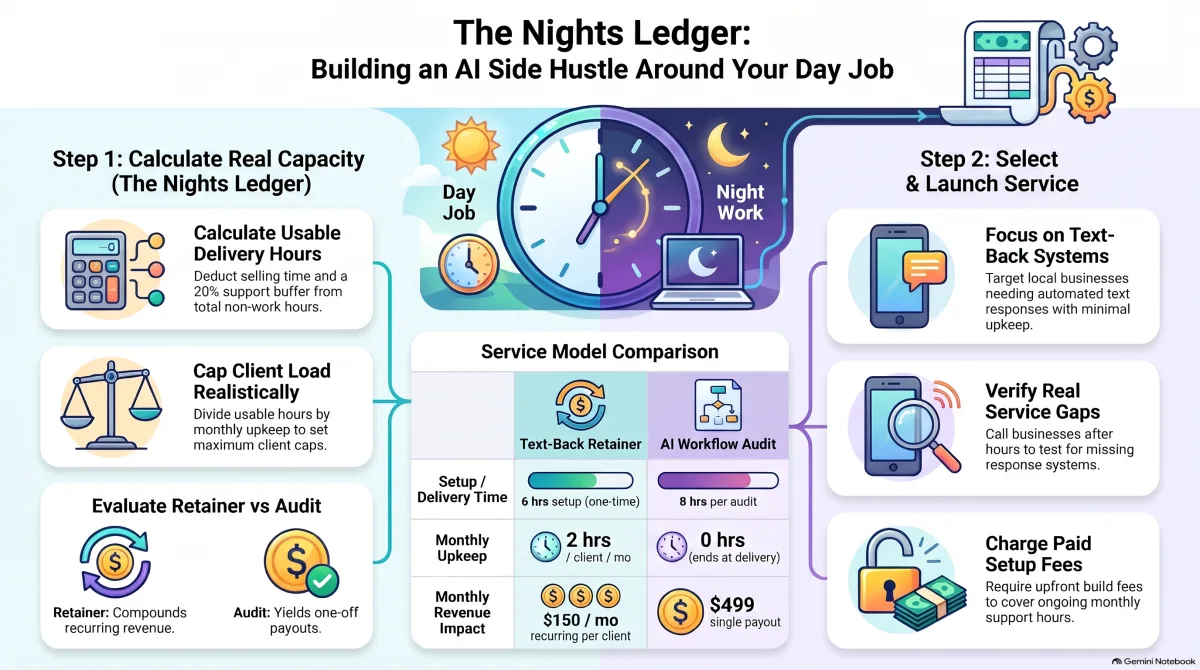
Fill this in before you pick a service, price a job, or contact a business. It's a capacity table, not a wish list. You can check every line against your calendar. The lines and starter settings are SHR's screening rules, not any vendor's policy.
- Hours you have. Nights plus weekends, per week, honestly counted.
- Hours per month. Line 1 × 4.33 (the average number of weeks in a month). This is your total budget.
- Selling hours. Prospecting, outreach, calls, follow-up. Cap it. The worked example uses two hours a week.
- Delivery pool. Line 2 minus Line 3.
- Support buffer. Hold back 20% of the delivery pool for fixes, questions, and things breaking. This line isn't optional.
- Usable delivery hours. Line 4 minus Line 5. This is what you can actually promise.
- Upkeep hours per client, per month. For the service you're pricing. Text-back: about two hours a month once it's running (example). An audit: zero after delivery, because it ends.
- Max clients. Line 6 ÷ Line 7, rounded down. This is a ceiling, not a target.
- Clients you can actually land. Your selling hours decide this, not your capacity. At two selling hours a week, one new client a month is a realistic starting pace.
- The verdict. Do the hours fit with the buffer intact? If not, the fix is fewer clients, a higher price, or a narrower scope. Never hours you don't have.
The math gate: one reader, two models, same nights
Here's a worked example with every input named so you can recompute it. All prices and hours are example inputs. Replace them with your real numbers.
The reader has 10 hours a week across nights and weekends, with selling capped at 2 hours a week. The service is missed-call text-back for local service businesses. Setup is $500 per client and takes 6 hours, once. Upkeep is $150 a month per client and takes 2 hours a month. The client pays for their own tool accounts directly. If you cover tool costs instead, subtract them from the retainer before you do this math.
The Ledger, filled in
- Hours you have: 10 per week
- Hours per month: 10 × 4.33 = 43
- Selling: 2 per week = 9 per month
- Delivery pool: 43 − 9 = 34
- Support buffer (20% of 34): 7
- Usable delivery: 34 − 7 = 27
- Upkeep per client: 2 per month
- Max clients: 27 ÷ 2 = 13 (a ceiling, not a target)
- Clients landed at one a month: 6 after six months
Month six
- Upkeep: 6 clients × 2 hours = 12 hours
- Selling: 9 hours
- Total committed: 21 hours a month, inside the 43, buffer intact
- Recurring revenue: 6 × $150 = $900 a month
- Setup fees collected along the way: 6 × $500 = $3,000 one-time
- Effective rate that month: $900 ÷ 21 hours = about $43 an hour gross, before taxes and any tool costs you cover
Run two stress tests on your own numbers. First, if upkeep is really 4 hours per client instead of 2, the ceiling halves (27 ÷ 4 = 6 clients), and month six is already at the limit. That's why the buffer exists, and why timing your first client's real upkeep hours matters more than any price guide. Second, if a client cancels, revenue drops $150 and frees 2 hours. Retainers aren't permanent. Your selling hours are what replace them, so they never drop to zero, even when you're full.
The same nights, sold as one-off audits
- Audit price (example, inside Vantaige's band): $499
- Hours per audit (example): 8, made up of interview 1.5, analysis 3, report 2, walkthrough call 1.5
- To match $900 in a month: $900 ÷ $499 = 1.8, so 2 audits
- Hours: 2 × 8 = 16 delivery + 9 selling = 25 hours
- Revenue that month: 2 × $499 = $998
- Revenue next month before you sell anything new: $0
Both models fit the same nights. The difference is what next month looks like. The retainer model starts month seven at $900 before you sell anything. The audit model starts month seven at $0 and has to sell all over again. Recurring revenue isn't magic. It's upkeep hours that add up. One-off revenue isn't failure. It's a model that resets every month. Pick the one whose next month you can live with.
Check your own version with the Income and Hourly Pay Calculator. It shows your true hourly pay after time and expenses, so you can compare it to your day job.
This is also where the "passive AI income" myth falls apart. $900 a month for 21 hours of work is a part-time job's hours at about $43 an hour gross. Nothing in the Ledger happens while you sleep. The systems run while you sleep. The setup, judgment, and upkeep are yours, at night, on purpose.
How to land client one
Prospecting on nights has one rule: the gap has to be real and specific to that business, not a generic "you need AI" pitch.
- Pick one niche. Local trades, salons, clinics, or cleaners. Pick one kind of business so your message scripts and knowledge carry over from client to client. Ten clients in one niche beat ten clients in ten niches, because each setup gets faster.
- Build a list of ten from Google Maps. Then check the gap yourself. Call each one after hours, once, and note what happens. No answer and no text back is a gap you can name. If someone answers, they aren't a text-back prospect. Cross them off.
- Send five emails, not DMs. Line one is the gap you actually saw: "I called Tuesday evening and got no answer and no text back." Line two is the offer with a number: "Missed-call text-back, set up in one week, $500 setup and $150 a month." Line three is one next step: "A 15-minute call Thursday evening?" Track every send and reply with the business and the date.
- Charge for setup. The free part of your offer is the note naming the gap. The build is paid. A free build turns into an unsupported client who messages you forever, because nothing in writing says what support costs.
- Offer the audit first if the retainer stalls. An audit is a smaller commitment than a monthly retainer, and it ends with a ranked fix list, which often puts text-back or a workflow at number one.
Who should wait
Wait if your honest hours number is under about six a week. At that level the Ledger leaves no room for a buffer, and one broken system eats the whole business. Wait if you can't name one niche you understand well enough to write its messages. Wait if your employment contract bars side work in your employer's industry and that's your niche. Check the contract before the first pitch, not after the first client.
Friction: what AI services do to you
Texting and recording consent
Two separate sets of rules apply. First, texting. Businesses need proper consent to send marketing texts, and US carriers require business texting from regular phone numbers to be registered (A2P 10DLC) before messages flow reliably. Twilio's A2P 10DLC documentation explains the process. A setup isn't "done" until registration is approved. Second, call recording. Consent rules vary by state, so if a service records calls, the client needs proper notice and consent for their state before recording starts. This isn't legal advice. Check both, for each client, in their state.
Made-up answers
AI systems can invent details: wrong hours, wrong prices, services the business doesn't offer. Your review is part of the product. Every fact the system tells a customer should come from a script of business facts you wrote and checked, not from the model's general knowledge. If the system can't answer from that script, it should hand off to a human instead of guessing. A client who catches their own system inventing a price won't renew, and they'll be right.
Data access
You'll hold client logins, customer phone numbers, and CRM access. Put the scope in writing: which accounts, for what purpose, for how long. Use the client's own accounts wherever possible so their data stays in their systems, not on your personal devices. Don't keep customer data longer than the job needs, and say so up front.
Day-job conflicts
Check your employer's rules on side work and conflicts of interest before the first pitch. Don't use employer time, equipment, or client lists for the side business. One complaint from your employer costs more than a year of retainers.
Support creep
Once clients have your number, they'll message at all hours. Set support windows in writing, for example weeknights plus one weekend check, and define what counts as an emergency (their phone system is down) versus what can wait (a message tweak). Without windows, a $150-a-month client becomes an always-on job, and your Ledger hours quietly double.
Churn and tool breakage
Monthly clients cancel. A business gets sold, hires in-house, or just stops answering. Price setup separately so a cancellation doesn't wipe out your pay for the work, and keep selling even when you feel full. Vendors also change prices, change their integrations, and shut products down. A shutdown means a rebuild, not a fix, so tell the client that up front, and keep scripts and workflow maps in documents you control.
For the wider picture, see the AI side hustles for beginners hub. If you'd rather build an asset than sell hours, compare calculator and directory websites. Still choosing a lane? Start with how to start a side hustle.
The test: this week, one Ledger, ten names, five emails
Don't buy any tool and don't promise anyone anything yet. Here's the plan:
- Write down your honest weekly hours and fill in the Nights Ledger for missed-call text-back with your numbers: selling hours, buffer, upkeep per client, max clients.
- Pick one niche. List ten businesses in it from Google Maps. Call each one after hours, once, and write down what happened: answered, rang out, voicemail, text back, or nothing.
- Send five emails to the ones with a real gap: the gap you heard, the offer with a price, one next step. Track every send and reply with the business and the date.
- Book one paid conversation, an audit or a setup, at your real price. No free builds.
Failure diagnosis. If nobody replies in two weeks, it's almost always one of three things, in this order. The gap wasn't specific (rewrite line one with something you actually heard on their phone). The niche was wrong (businesses that reliably answer their phone don't need text-back, so switch to one where calls ring out). Or the offer was unclear (a price and a next step beat a paragraph about AI). Never drop the price to zero. A free build doesn't fix a prospecting problem. It just gives you an unsupported client. If you close deals but the hours overrun, your Ledger was optimistic. Cut clients, raise the price, or narrow the scope.
Nothing in this guide says what you'll earn. The math shows what one model pays under stated assumptions. Change an assumption and the answer changes, which is why the Ledger exists.
Get the next guide
Want the next guide in this series when it lands? Sign up for the Side Hustle Radar newsletter. That's the only ask on this page.